virtualDavis

ˈvər-chə-wəlˈdā-vəs Serial storyteller, poetry pusher, digital doodler, flâneur.
Twitter
@virtualDavis

Storytelling Is Just the Beginning

Talk about the future of journalism often takes on a victim-istic tenor. [But] there’s poetic sensibility in his [David Schlesinger’s] words:

Knowing the story is not enough. Telling the story is only the beginning. The conversation about the story is as important as the story itself.

[…] Along this line, he clearly sees Reuters embracing social media:

What is great about 2010 is that technology has created a completely new concept of community. And it has given that community new powers to inform and connect.

[…] Schlesinger goes on to say the Reuters model will combine the best of both worlds, “the professionalism of the journalist and the power of the community.” Underpinning the Reuters approach, storytelling remains a core tenant as Schlesinger shares:

If we have learned anything from these past two years, it has been that pure facts are not enough. Pure facts don’t tell enough of the story; pure facts won’t earn their way… We’ve been drowning in facts, and that deluge continues to threaten.

[…] What Schlesinger has written is more than an insider’s look at Reuters adjusting to a digital world that puts the consumer in charge.It’s a manifesto for news organizations around the world.(Ishmael’s Corner)

Lou Hoffman’s post about the merits of storytelling communities (ie. nexus of conversations provoked by a story) is a thoughtful and refreshing counterpoint to the woe-is-me grumbling we hear so much lately.

He is reacting to David Schlesinger’s post, “Changing Journalism; Changing Reuters”, and I’ve excerpted some of the most compelling thoughts from both of them above. (Note: I’ve condenced their paragraphs to simplify the layout.)

This notion that the future of journalism — and to a large degree, storytelling, in general — lies in sharing, interaction and community is thrilling. And it’s totally accurate. One-way information is dying. Journalism and storytelling will become more democratic in the process, allowing a much broader conversation to replace the top-down approach that has long prevailed. Citizen participation. Citizen journalism. Open source journalism! It’s exciting. And it poses all sorts of new challenges. Fact checking, for example. And curatorship. As more and more content is generated and aggregated from increasingly diverse sources, it will become more and more inportant to sort, organize and filter the flow if information. This challenge of curatorship will be one of the critical areas of innovation over the next decade.

And last but not least, Schlesinger’s comment about the limitations of facts, reminded me of that old story about two beautiful young maidens, Truth and Story… Let’s see if I can find it!

Enhanced by Zemanta

Projeqt Your Story

 Introducing ProjeqtIt looks like the newest entry to the online storytelling bonanza, projeqt, is sexier than Intersect and Storify, but less useful. Minimalist can be good, especially from a design perspective. But as a storytelling tool, projeqt appears to be pretty limited. (Check out the video introduction here.) And waaayyy too linear. Web enabled digital storytelling should open up whole new realms of non-linear narrative. Time to leap-frog past hum-drum slideshows, even when they look pretty and allow video, etc. It’s worth noting that I haven’t been under projeqt‘s hood, so I judge prematurely. And since they’re still in beta, I probably won’t get a more ample perspective any time soon. (I did sign up to beta test. Maybe I’ll be able to share a surprising, exciting update soon?)

Despite my reservations, there’s tons of potential for this project. And their vision is spot on!

Your story is who you are and how your story gets told is just as important as the story itself. Great stories keep us riveted to the page. Or the screen (whatever shape or size it happens to come in.) Great stories get shared and are retold time after time after time. Great stories always leave us wanting more. Projeqt gives you the tools and technology to tell your story. It provides a robust architecture, with unprecedented flexibility and possibilities. Projeqt is about giving you the power to projeqt your story to the world.

My hopes are high. And my enthusiasm for the current proliferation of storytelling apps and websites is legendary!

Update:

The year is a-waning (scarcely a week left in 2010), but still no word fromprojeqt. Hmmm… Beta boy is offering to bust a move, but so far no beta invitation. So, I still can’t comment on the underbelly of the beast. Nor does much new content seem to be emerging. If you’re looking for a quirky tour of what can be generated with this platform, meander through the Brain Pickings projeqt.

Brain Pickings


I’m not sure that this example (or any of the other currently published examples) demonstrate projeqt’s gotta-have-it awesomeness, but it did introduce me to Brain Pickings, and now I’m hooked!

Brain Pickings is about curating interestingness — picking culture’s collective brain for tidbits of stuff that inspires, revolutionizes, or simply makes us think. It’s about innovation and authenticity and all those other things that have become fluff phrases but don’t have to be.

The site is slooowww, at least lately, but it’s well worth the wait. Fascinating and fun and packed full of provocative ideas, links, videos, etc. Check out Maria Popova’s How To Be Alone for a refresher in (introduction to?) solitary contentment. Here’s the I-bet-you-can’t-resist-watching-the-whole-thing video:

[youtube=http://www.youtube.com/watch?v=k7X7sZzSXYs&w=335&h=276]

Top 10 Ways to Tick People off

First of all, it’s actually a top 32 list, but that wouldn’t have made for such a catchy title. Forgive me. And a grateful hat tip to Joe Crawford of ArtLung who lifted me high above the icy roads and gloomy gray last January when I stumbled onto his list, “How to Tick People Off“.

It made me laugh. Not the “Harrumph!” kind of laugh that most email forwards prompt before deciding not to pass them along. More like an I-hope-I-don’t-wake-up-my-wife-and-have-to-explain-why kind of laugh. That wouldn’t stop. And maybe, if you’re a little irreverent and you don’t take yourself too seriously you’ll understand why. In a few seconds. When you read the list.

But first, it’s worth noting that I’m posting this list over nine months after first reading it. Why? Because I didn’t really intend to share it. I try to avoid amplifying the noise. To many, these 32 opportunities to laughcertainly would be considered noise. And why waste time formatting the list, posting it, etc. If it doesn’t challenge my readers, inspire them, etc. it wasn’t worth doing. That was then. Since then I’ve revisited the list from time to time. Not often, but on those $#!% storm days when a lifeline (or a laugh line) is welcome. I had one of those days this week. The good news is that it was a short-lived doomsday. The better news is that it motivated me to pass along this goofy gray day antidote. If you don’t like it, stop reading it. If you’re offended, sorry. But if it adds a little levity when you’re feeling the weight of the world on your shoulders, perfect. That’s the idea. To make you chuckle. To remind you that life’s not quite so serious as it sometimes seems. Laughter is good medicine… Okay, some of these are better than others. And a few are lame. Or just plain rude. But most are funny. Silly, yes, but funny. Enjoy!

    1. Leave the copy machine set to reduce 200%, extra dark, 17 inch paper, 99 copies.
    2. In the memo field of all your checks, write “for sexual favors.”
    3. Specify that your drive-through order is “TO-GO.”
    4. If you have a glass eye, tap on it occasionally with your pen while talking to others.
    5. Stomp on little plastic ketchup packets.
    6. Insist on keeping your car windshield wipers running in all weather conditions “to keep them tuned up.”
    7. Reply to everything someone says with “that’s what you think.”
    8. Practice making fax and modem noises.
    9. Highlight irrelevant information in scientific papers and “cc” them to your boss.
    10. Make beeping noises when a large person backs up.
    11. Finish all your sentences with the words “in accordance with prophesy.”
    12. Signal that a conversation is over by clamping your hands over your ears and grimacing.
    13. Disassemble your pen and “accidentally” flip the ink cartridge across the room.
    14. Holler random numbers while someone is counting.
    15. Adjust the tint on your TV so that all the people are green, and insist to others that you “like it that way.”
    16. Staple pages in the middle of the page.
    17. Publicly investigate just how slowly you can make a croaking noise.
    18. Honk and wave to strangers.
    19. Decline to be seated at a restaurant, and simply eat their complimentary mints at the cash register.
    20. TYPE IN UPPERCASE.
    21. type only in lowercase.
    22. dont use any punctuation either
    23. Buy a large quantity of orange traffic cones and reroute whole streets.
    24. Repeat the following conversation a dozen times. “DO YOU HEAR THAT?” “What?” “Never mind, it’s gone now.”
    25. As much as possible, skip rather than walk.
    26. Try playing the William Tell Overture by tapping on the bottom of your chin. When nearly done, announce “No, wait, I messed it up,” and repeat.
    27. Ask people what gender they are.
    28. While making presentations, occasionally bob your head like a parakeet.
    29. Sit in your front yard pointing a hair dryer at passing cars to see if they slow down.
    30. Sing along at the opera.
    31. Go to a poetry recital and ask why each poem doesn’t rhyme.
    32. Ask your co-workers mysterious questions and then scribble their answers in a notebook. Mutter something about “psychological profiles.”

(courtesy of Joe Crawford, “How to Tick People Off“)

Did you laugh? I hope so. Number 29 resonates for me because cars, tractor trailers, dump trucks, etc. routinely exceed the 30mph speed limit in front of my house. 75mph isn’t unheard of! So if you see me sitting in a lawn chair pointing my wife’s hairdryer at you, you better slow down!

And by the way, I’d recommend you not actually do any of these things. But, if you’re clever, maybe you can come up with a few more… If you do, please send them along.

Update:

I’ve received a couple of worthy additions:

33. Ask women if they’re pregnant, and when they say, “No, why?” glance at their midsection and look away quickly. (Patricia Greathouse)
34. Park across someone’s driveway and then go to work for the day. (Kathryn Cramer)

Enhanced by Zemanta

Writing Concisely

If somebody sets out in great detail what is before us, we very quickly become bored. That is not the way we see the world; we look for salience, we look for the feature that will engage our interest… The trouble with overwritten prose is that it takes away from the reader the opportunity to imagine a scene. We do not want to be told everything; we want a few brushstrokes, a few carefully chosen adjectives, and then we can do the rest ourselves. (Wall Street Journal)

Crisp, concise language sounds like a worthy goal. And indeed it is. But words are so delicious, so tempting, so distracting. It’s often quite difficult to cull the best and lose the rest. Especially because we writers like words, collect words, romance words, get totally distracted words… See where I’m going? It can be damned difficult to weed out all the superfluous language. Even when we know it’s the right way to write!

Alexander McCall Smith’s article, “Block that Adjective“, hits the nail on the head:

“For some people, being able to use all these words is rather like being faced with a chocolate box with multiple layers; the temptation to overindulge is just too great.”

Yup. I’m one of those chocolate lovers. Hello, I’m George Davis, and I’m a word glutton. Recognizing I have a problem is half the battle right? Nope. Not even close. It’s a fresh battle each time I sit down to edit what I’ve written. Clean out the clutter. Clean out the distractions. Clean out the overindulgence. What’s left? The essence. The story…

Enhanced by Zemanta

Ira Glass: How to Build a Great Story

Ira Glass on How to Build a Great Story

If Bob Dylan and Willy Nelson are two of the most unique voices in music, Ira Glass has to be one of the most unique voices in storytelling. Don’t you think? His slightly nasal voice, awkward cadence and captivating delivery absolutely suck me in.

And Ira Glass isn’t just a master storyteller; he’s a master story crafter. In this series of four YouTube videos Glass explores the building blocks of a great story. Take a few minutes. You’ll learn something. And you’ll enjoy it!

His humility is encouraging, especially when he samples the reporting he was producing after a half dozen years in the business. By his own admission, there was still so much improvement needed, so much learning. All storytellers know this, but it’s helpful to be reminded by a storyteller with a weekly audience of 1.7 million (according the the statistic he offers in the video) to remind us that their is always plenty of improvement to strive for. Even after years of practice!

La Double Vie de Véronique

[youtube=http://www.youtube.com/watch?v=ihZ1TB9KzGQ&w=335&h=279]

Trailer for The Double Life of Veronique (video via youtube.com)

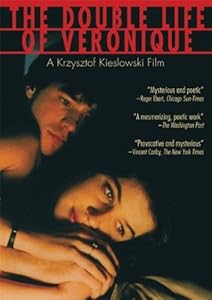
This is an exceptionally poor trailer for a remarkably good film, Krzystof Kieślowski‘s The Double Life of Veronique (La double vie de Véronique). I watched it for the second time a few nights ago and was dazzled all over again. Irène Jacob, who also stars in Kieślowski’s Red (Three Colors Trilogy), plays both leads, Weronika, a spritual and somewhat mysterious Polish soprano, and her doppelgänger, Veronique, an often melancholic French music instructor. Both women are intuitive and inexorably fueled by conviction and curiosity. Despite intriguing bookends to the film in which Weronika and Veronique overlap obliquely for a few seconds, their lives echo — almost rhyme — without knowing one another. The audience is left to decipher the uncanny link between them.
Cover of

Cover of The Double Life of Veronique

Despite Kieślowski’s death in 1996, his films continue to provide essential oases in the Hollywood-saturated film industry. He ignores dramatic cliches and conventions in favor of a more stripped-down, more honest storytelling. As drawn to character as to plot (if not more so) Kieślowski invites us to wonder and question and yearn. The Double Life of Veroniqueis filled with this yearning. What am I talking about? In Annette Insdorf’s film commentary packaged with the Criterion Collection DVD of the film, she describes “rich characters moving through landscapes and situations that force them to grapple with something beyond their immediate circumstances…” Insdorf, a professor in the Graduate Film Program of Columbia University’s School of the Arts and author of the Kieślowski biography Double Lives, Second Chances returns to this idea in an interview with the Columbia University Record:

“you’re made aware that there is something more at work than what the eye can see. At the risk of sounding fuzzy, I’ll suggest that there is a spiritual dimension embedded in his sensual textures… There’s a kind of yearning nostalgia for a world beyond the reach of the characters.”

Kieślowski’s unique screenwriting, directing and editing are complemented in The Double Life of Veronique by Zbigniew Preisner‘s mesmerizing operatic composition. This ethereal, haunting score weaves Weronika and Veronique’s parallel stories — as well as several layers of storytelling (puppeteering, children’s fiction, adult fiction, musical performance) — into a hypnotic and haunting tapestry. A tapestry that can be taken down from the wall when the film ends and taken to a chair by the hearth, wrapped around you while you ponder what you’ve just experienced, while you hum and question in the afterglow. Unless, of course, you can’t resist the temptation to leave the tapestry on the wall to watch all over again. I did!

Stories: Relief from the Darkness

[youtube=http://www.youtube.com/watch?v=S0fpKtxsqN8&w=335&h=279]

Pour yourself a cup of tea and toss a few pop rocks down the hatch. Now lean back and enjoy this quirky visual tale about the power of stories. Dabbling in childish imagery but presented in a decidedly adult collage, this video ditty is an enjoyable reminder why storytelling is so compelling. Although I need a little help with “devine”…

Enhanced by Zemanta

Publishers Perform Roles That Writers Need

The definition of “book publisher” is up for grabs, and those in the industry will have to be brave and imaginative, in double-quick time, to lay claim to this new definition. Others might find it easier to begin with a blank sheet.

At heart, publishers exist to create more value for writers than writers can (or wish to) create for themselves. It’s clear that the specifics of this role are changing. Some writers have decided that they can create as much value as they need alone, and feel freer by doing it themselves. Elsewhere there is a debate about where the line lies in a fair return for licensing copyrights, particularly when it comes to older books. Fundamentally, though, the need for publishers endures, even if not in their current form. Readers will be best served by publishers who can marry the best of what is sometimes labeled “legacy” publishing to the new means of developing and delivering what readers want and writers need. (The Guardian)

Stephen Page’s post about the future of publishing is level headed and insightful. He steps away from the increasingly popular bashing of “old publishing” and acknowledges that these legacy book publishers have a distinct advantage if they can adapt quickly. Others have lambasted the traditional publishers for failing to anticipate the tide change. I myself have nagged at this point. But Page reminds us that even as latecomers to the party, existing book publishers stand to reap significant rewards if they can quickly overcome four challenges:

  1. Publishers must update their digital royalty rates.
  2. Publishers must provide high-quality editorial support.
  3. Publishers must build audiences for writers, on and off-line.
  4. Publishers must embrace (and accelerate) technological innovation.

If traditional publishers can quickly, efficiently meet these challenges, “the persistent reporting of the death of old publishing will continue to be mere exaggeration.” Point well taken. But so far, most traditional publishers seem more intent on resisting change — clinging to a model they know and love — than leap-frogging forward. Of course, it’s early, and the race is too the swift and the wise.

Enhanced by Zemanta

Publishing Chain; Vanishing Links

“Technology has made virtually anything possible,” says Neill Denny, editor-in-chief of the publishing industry magazine The Bookseller. “If you look at it conceptually – there’s a five-link chain between the person who writes and the person who reads. You’ve got Author-Agent- Publisher-Retailer-Reader. Theoretically, the three middle bits could all now vanish and the author could write online directly to the reader.”

However, he continues, “A more likely possibility is that just one of the three central links will vanish on-line. It could be that Amazon, the retailer, becomes the publisher. Or that the agent becomes the publisher, or the publisher becomes the retailer, and you go to a publisher’s site to buy the book. One of those links will certainly disappear on-line. We just don’t know which.” (The Independent)

John Walsh’s article “E-books: the end of the world as we know it” offers no new insights, but a handy summary. More intriguing though are the comments which are worth a wade through. A few flaring tempers, a few snarky jabs, and plenty of voiced growing pains as we tramp through the clumsy not-altogether-painless publishing revolution.

Enhanced by Zemanta

Mario Vargas Llosa Wins Nobel

The Peruvian writer Mario Vargas Llosa, whose deeply political work vividly examines the perils of power and corruption in Latin America, won the 2010 Nobel Prize in Literature on Thursday… Announcing the award in Stockholm, the Swedish Academy praised Mr. Vargas Llosa “for his cartography of the structures of power and his trenchant images of the individual’s resistance, revolt and defeat.” (NYTimes.com)

In my senior year at Georgetown University I had the good fortune of sudying with Peruvian writer Mario Vargas Llosa. I was already a fan of his fiction, and the opportunity to meet with this wise, gentile man of letters for several hours each week to ruminate on his favorite jewels in the Latin American literature crown was arguably the highlight of my four undergraduate years. I also had the good fortune of translating a nonfiction essay for Mario Vargas Llosa for publication in The Georgetown Journal. I offer this background to underpin the depth of my pride and excitement when Mario Vargas Llosa won the Nobel Prize for Literature.

With his typical grace and commitment to literature Vargas Llosa has focused on teaching Borges at Princeton and avoided the pomp inevitably accompanying his laureatship. He acknowledged the sometime comic results of winning the Nobel Prize including a solicitation to invest the approximately $1.5 million into an ice cream venture!

But Vargas Llosa prefers Borges to ice cream. I remember this from my days in the classroom with him, so it’s ironic that he’s currently teaching the work of his Argentine hero who never won a Nobel.

Our great writers have all been prolix… Borges is the opposite—all concision, economy, and precision. He is the only writer in the Spanish language who has almost as many ideas as he has words. He’s one of the great writers of our time. (Paris Review)

This reverence for Borges endures, and it’s not altogether unlike the admiration I have for Vargas Llosa. And not just for his writing, but also for his grace. But this for another day…