virtualDavis

ˈvər-chə-wəlˈdā-vəs Serial storyteller, poetry pusher, digital doodler, flâneur.
Twitter
@virtualDavis

Natalie Merchant’s Lyrical Poems
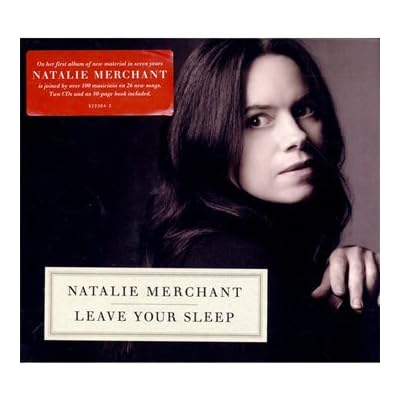
I’m back on The Lyrical Merchant again. After posting “Natalie Merchant sings old poems to life“, I jumped in my jalopy and zoomed off to Plattsburgh where I purchased her new album, “Leave Your Sleep“. I spent the afternoon meandering slowly homeward through the Champlain Valley, up and over Willsboro Mountain and finally into Essex. I took the most roundabout routes, was passed again and again by racier drivers, savored each velvety word Natalie Merchant sang.

Wow! This is a whole new chapter in this highly capable singer/songwriter’s career. Each song, each poem, opens up a new world, a new sound, a new rhythm. Her energy is so fresh and unique. She seems so comfortable in her skin, not straining to deliver something pop and flashy. Frankly this double CD album feels more like swinging by her home on a rainy afternoon and hanging out in sock feet and wool sweater and drinking tea (or an old Burgundy) and musing on life with an old friend. I don’t mean to suggest that the songs are all melancholy or low energy. Some are both. Most are neither. But they are comfortable and accessible. A funny description for a collection of poems since poetry can sometimes feel contrived, self-conscious or inaccessible. In a recent PBS interview Merchant talked about how she tackled the potential ungainliness of poetry in new album. (Watch the video.)

“Poetry comes alive to me through recitation. Even when I was working on this project… I couldn’t comprehend the meaning, and I couldn’t really understand the structure, the internal rhythms and rhymes… I would have to recite it or speak it, hear the words, and feel the words in my mouth.”

This idea of recitation, of speaking, mouthing, tasting poetry to understand it is helpful. I think of wine. To fully appreciate wine — its nuances, structure and narrative — you have to open the bottle, take a swig and slosh it around a little bit. Chew on it. See how it tastes and feels even once you’ve swallowed it. Sometimes the title of a poem or the label on a bottle of wine will mislead us, offer false expectations or undersell the contents. Sometimes a quick read or a swig with a mouthful of steak will get the job done. But why? To what end? Slowing down and biting off a verse of poetry, a mouthful of fermented grapes and letting it roll around in your mouth, slowly is what works best. Natalie Merchant seems to be reminding us of this. “A poet transports you to a place where you can experience what they saw, what they felt, what they smelled, what they touched,” she reminds us in this video and in every single song on “Leave Your Sleep“.

So why the dramatic departure? Well, she had a baby, became a mom, took a half-dozen years reprieve from the pop scene. Or maybe this album is a smaller leap than it initially seems. I’ll leave that judgment up to you.

“I started talking about the plan to age gracefully in this field fifteen years ago… I could see my future: I’m going to be shaking my booty when I’m fifty five. I need to come up with a way, and there’s so much music I’ve wanted to write and that I’m interested in that didn’t really fit into a pop album format. And now’s my time to start exploring that.”

If this is the first chapter of that exploration, then I am optimistic. It promises to be a great journey!

Enhanced by Zemanta

StoryKit Digital Storytelling Application

StoryKit digital story app (Credit: The Tech Savvy Educator)

I got really really excited about an application I recently downloaded for the iPod Touch, and wanted to share a short preview, nothing too fancy. I’ve been coordinating my buildings efforts to pilot some iPod Touches, leading up to an eventual full classroom trial this fall, but in the meantime, we’re figuring out where these little devices might be useful in the classroom. Lots of people decry the use of the iPod since it’s primarly a consumption device, but there are some decent publication and creation applications as well, including StoryKit, a completely FREE digital story creation application! (The Tech Savvy Educator)

Ben Rimes’ video preview of StoryKit for the iPod Touch is yet another indication that digital storytelling has become mainstream, and that tools will continue to emerge that simplify the creation and sharing of digital stories. Although this app looks pretty basic, it’s user-friendly and free! I suspect that digital storytelling will be the next PowerPoint!

Read the full blog post at The Tech Savvy Educator.

An Ann Arborite in Paris

I often take to wandering the city [Paris] toute-seule and although I do tend to find some really neat things, or things that I really didn’t expect to come across (especially in the 16th) I still think that this a city of meeting up with people, of being headed to somewhere where a group awaits you. I’ve often wondered how a Parisian would survive in Ann Arbor.

Yesterday’s post on La Flânerie was a halting but thoughtful rumination on cultural/social differences between studying abroad in Paris and living in cozier, more familiar Ann Arbor, Michigan. And more too… the differences between solo flânerie and group meandering, between France and Spain, between urban and rural. In closing Emily affirms that she’ll continue trying to understand Paris, but she also leaves us with a more universal and contemplative question: “So how are some people so easily flowing in the hyper-social society while others are perfectly content to have their jobs and come home… and stay there?”

Read the full post at Em Wanders Paris.

Enhanced by Zemanta

Natalie Merchant Sings Old Poems to Life

[youtube=http://www.youtube.com/watch?v=vXVCf5VTHrw&w=330&h=275]

Spectacular! Emotion-bending. Destiny changing… Have you watched (listened to) Natalie Merchant’s TED performance? She performed a sampling from her new album, “Leave Your Sleep”, the culmination of six years spent adapting 19th-century children’s poetry — some obsolete and all but forgotten — to music.

Merchant’s seven-year sleep has blossomed into this double album of poems set to music that traverses the whole range of American vernacular, from Bluegrass to Cajon to miniature chamber music, and beyond.”(Financial Times)

Merchant awakens Charles Edward Carryl’s “The Sleepy Giant” observing, “Little boys do not like being chewed.” The album includes poetry from Rachel Field, Robert Graves, Christina Rossetti, Robert Louis Stevenson, Ogden Nash and Edward Lear. In the video she performs Nathalia Crane’s “The Janitor’s Boy”, E.E. Cummings’ “maggie and milly and molly and may”, Laurence Alma-Tadema’s “If No One Ever Marries Me” and Gerard Manley Hopkins’ “Spring and Fall: to a young child”. Each sung poem is fresh, inviting and peppered with poignant asides. A comment beneath the YouTube video captures Merchant’s beguiling potency:

“Here she goes again! The angel of sound, rewiring more minds. Once she gets in there, you’ll never get her out again. Just shut it out! Don’t listen! If you do, she’ll make you more human! Run!”

Returning to the stage for an encore, Merchant introduced her final rousing performance: “I’d like to thank everybody… everyone that blew my mind this week. Thank you.” Then she launched into a rousing rendition of “Kind & Generous”, so rousing that she actually interrupted the song and asked the audience to sit, to listen, to consider.

“I still have two minutes… That’s innovative, don’t you think? Calming the audience down… I’m supposed to be whipping you into a frenzy and I… that’s enough… Shhh.”(Natalie Merchant)

So, destiny changing? A stretch, maybe, but Merchant is one of so many voices leading me back to poetry recently. I’m following the siren call, wondering where I’m being lead. And maybe I’ll manage to squeeze in a Natalie Merchant concert along the way…

Enhanced by Zemanta

Do We Need to Kill Social Media?

Unfortunately, today’s “social media” conversation is all too often like the Buddha on the road. Instead of discussing the profound impact the phenomena is having within businesses, society and brands, the conversation is often focused on setting up a Twitter account or the next “viral video” — tempting eye candy that shifts the attention away from the transformative nature of this emerging form of human communication. It can be argued that the term “social media” itself is stunting the potential of the very force it is trying to describe and, hence, has outlived its usefulness.

via imediaconnection.com

Enhanced by Zemanta

Digital Storytelling Rocks

Telling stories is as old as the hills, as human as compassion and love, as necessary as air, sleep and chocolate. Fast forward to the digital age! Storytellers are inheriting more magical tools and techniques every day. Sounds, still and moving visuals, interaction, sharing, accessibility… This is the world of digital storytelling. Love it or hate it, it’s here to stay! (Amplicate.com)

What’s your opinion on Digital Storytelling?

Are you familiar with Amplicate.com? It’s new to me. Always more fun to experiment than stand on the sidelines and watch, right? So I dove in! According to the mission statement on their homepage, “Amplicate collects similar opinions in one place; making them more likely to be found by people and companies.” Hmmm… Not so sure about companies, but there may be a few people out there who want to weigh in on the merits and demerits of digital storytelling. Do you think digital storytelling rocks? Or do you think digital storytelling sucks?

Enhanced by Zemanta

Digital Storytelling

Image and quotation via tech4k12.blogspot.com

Digital Storytelling is the modern way to tell a story. Any story.  Storytelling is a practice that has been around for as long as man has been talking.

There are several resources available for teachers to include digital story telling in their instruction.  Microsoft has recently published the Digital Storytelling E-Book, and have also created some guides to get teachers started with Windows Live Movie Maker, and Photo Story 3, both free downloads from Windows Live.

In October, 2007 educator Alan Levine evaluated 50+ on-line tools that you can use to create your own web-based story. He used each tool to create the same story so you can evaluate the differences yourself. See all the results at his wiki http://cogdogroo.wikispaces.com/StoryTools

Enhanced by Zemanta

Fears Grow over Gulf of Mexico Oil Spill

[youtube=http://www.youtube.com/watch?v=QUH0Da9-Zns&w=300&h=250]
“Fears grow over oil spill disaster” (Video via youtube.com)

Is this the understatement of the year: “These guys [BP] don’t have a great record in taking care of people’s health and safety.” This comment, made by Greenpeace’s Mark Floegel about BP’s insistence that shrimpers, fishermen, etc. who wish to assist in the clean up effort must first sign a BP indemnification waiver. (Note, this quotation comes at about 2:20 in the video.)

Google is leveraging its multimodal muscle via the Crisis Response pageto help cover the oil spill, aggregating timely content and publishing updated Google Earth layers to help visualize the scope, evolution and impact of the spill.

“Google is taking a major (though low-profile) step into the realm of crowd sourcing news. Users can upload their videos of the spill or news related to the Gulf oil spill, and the videos are published to a YouTube playlist, making a video record of the disaster and what is being done on the ground to stop it.” (Mother Nature Network)

Perhaps this is the silver lining? Citizens around the world are quickly learning to contribute to the story, create history as it’s made, participate in the global dialogue that until recently was interpreted and disseminated by a few. Citizen journalism is open journalism! This shift is exciting and inspiring. The democratization of information, of news, of history. Can open government be far behind?!?!

Enhanced by Zemanta

Dries Buytaert on DrupalCon San Francisco

DrupalCon San Francisco ended a few days ago, so once again I’m sitting here with post-DrupalCon blues, trying to wrap my head around what just happened, digging out my backlog of work, and rediscovering my usual rhythm. It happens to me every time, and it is a sign of having had a great time. In short, DrupalCon San Francisco was ‘fantastic’, a word I use sparingly. It is best expressed in numbers, like Matt Cheney of Chapter Three did in his closing session:

  • Roughly 3000 registered attendees at an average ticket price of $205 USD.
  • 357 days of preparatory planning, including 31 general meetings and 105 daily phone calls. Unlike in the old days, I only participated in one such phone call.
  • 408 proposed sessions of which 131 sessions were accepted and presented.
  • Rented 37 conference rooms covering 750,000 square feet of the Moscone center.
  • Organized a core developer summit with 150 attendees, 16 lightning talks, 11 breakout sessions and 1 Franciscan monk.
  • Trained 495 people on Drupal using 20 Drupal training classes.
  • 80 people sprinted on testing.
  • 21 people sprinted on documentation.
  • 120 people trained to be core contributors.
  • 120 BoF gatherings across 11 rooms.
  • 6000 people watched my keynote live, one big stage, and assisted by a backstage A/V team of 6 people.
  • 2 amazing keynotes; one from Tim O’Reilly and one from the Whitehouse, who is now an Open Source contributor.
  • Spent $25,000 USD on scholarship to sponsor 20 attendees.
  • Recorded 131 sessions on video with 24 hour turnaround.
  • Streamed 10 sessions live with up to 3000 simultaneous viewers thanks to Brightcove.
  • Had up to 2200 people use the internet simultaneous consuming a 92 megabit pipe. Whoever did the wifi at Moscone needs a raise.
  • 1100 t-shirts sold along with 320 Drupal umbrellas.
  • Raised more than $400,000 USD from 50 sponsors. Thanks to TrellonGravitekLabs,Chapter ThreeCommerce GuysAcquiaPhase2 TechnologyMicrosoft and Rackspace for being Platinum Sponsors.
  • 50 volunteers helping with registrations on the opening day of the conference.
  • One volcano and no volcano insurance.
  • Had a 24/7 coding lounge named after Chx along with free ice cream.
  • Free parties with open bar every evening.
  • 0 IE6 users on the DrupalCon website, 43% Apple users.
  • 60,000 unique visits and 30,000 unique visitors on the conference website during the conference.
  • 15000 e-mails, 7650 tweets, 35 press hits, 5 press releases and 1 television spot on ABC.
  • $691,677 USD estimated expenses, $1,004,470 USD estimated revenue, $312,793 estimated profit for the Drupal Association.
  • $72,000 spent on coffee.
  • A big thank you for Jennifer Lea Lampton, Stephanie Canon, Lauren Nicole Roth and Matt Cheney and hundreds of other people that helped.
  • Two new Drupal conferences announced; one in Copenhagen, one in Chicago.

via buytaert.net

I had to pass along these astounding stats that Dries posted on his blog yesterday about DrupalCon 2010 that I was fortunate enough to attend in San Francisco a little over a week ago. I’m familiar with the “post-DrupalCon blues” that Dries describes. I’m still trying to shake them! Frankly it was a mind-blowing few days. It’s thrilling to see how mainstream Drupal is becoming, how user-friendly, how diversified, how multi-media friendly… And 3k attendees?!?! It was totally overwhelming! In the good way. ;-)

And the White House keynote was inspiring. Open source. Open government. Open Democracy. Open world. The future is bright! And everyone’s invited! No silos. Just one big-@#$ circus tent… Come one, come all!

A huge thanks to Dries for dreaming up and sharing Drupal. It’s a major game-changer, not only for websites, not only for web developers and web designers. I think that we’re only just beginning to comprehend the scope and potential for Drupal. And your ongoing stewardship of this wild and woolly juggernaut is commendable too. Thank you.

Enhanced by Zemanta

Certified Organic?

Certified organic? (Photo credit: Fotolia)

Certified organic? (Photo credit: Fotolia)

“There aren’t any regulations to stop companies from labeling a product that contains dozens of synthetic ingredients with misleading words like “nature” and “health.” But, there is one exception to this rule: A label reading “certified organic” can’t claim this status if it hasn’t been properly certified. Here’s what you need to know about certified organic food.” (holykaw.alltop.com)

Hat tip to Guy Kawasaki for sharing this article forward on Twitter. Much helpful information to aid you in deciphering the increasingly tangled web around organic food production and retail. As for the question of reliability and enforcement, this article doesn’t offer too much assurance that we can 100% trust what we see in advertising or read on packaging. “Anyone who knowingly sells or labels a product “organic” that is not produced and handled in accordance with these regulationscan face a civil penalty of up to $10,000.” But is this a steep enough penalty to discourage fraud?

Read the full article at HowStuffWorks.com.

[This post was originally published as “Is USDA certified organic food safer than regular food?” on the Emmet Carter green design blog.]