virtualDavis

ˈvər-chə-wəlˈdā-vəs Serial storyteller, poetry pusher, digital doodler, flâneur.
Twitter
@virtualDavis

Lake Champlain Sunrise

[youtube=http://www.youtube.com/watch?v=_PnPlPukfj8&w=335&h=276]

One of my favorite experiences living in Essex, New York is watching the sun rise out of Vermont’s Green Mountains, reflecting across the surface of Lake Champlain. This morning, the dense cloud bank on the eastern side of the lake created a dramatic effect, a narrow glimpse of color and light, refracted on the bumpy water then gone, snuffed out almost as quickly as it began. Once the sun rose into the clouds the light flattened and the mood changed. An interesting start to this post-Labor Day week…

Enhanced by Zemanta

Smashwords: Your Ebook, Your Way

Image representing Smashwords as depicted in C...

Smashwords is an ebook publishing and distribution platform for ebook authors, publishers and readers… At Smashwords, our authors and publishers have complete control over the sampling, pricing and marketing of their written works. Smashwords is ideal for publishing novels, short fiction, poetry, personal memoirs, monographs, non-fiction, research reports, essays, or other written forms that haven’t even been invented yet.

It’s free to publish and distribute with Smashwords. (Smashwords.com)

I’ve been hearing more and more about Smashwords.com lately:

And just about everywhere else that folks are chewing the publishing industry fat. I’ve wandered their website and read miscelaneous tidbits here and there, but I’d really like to hear some firsthand accounts. Have you published a digital version of your book with Smashwords? What was your experience? Thanks!

Print Vs EBooks: Weeding out the Facts

While Amazon eBook sales now do exceed hardcover sales by a ratio of 1.43 to 1, we should remember that many of those “sales” are 25-cent downloads, many of them are free, and many of them are what, if we saw them in print, could be easily be mistaken for brochures rather than honest-to-goodness books. (Have you noticed every internet marketer seems to have a free Kindle or iPad edition of their latest “free report” these days?) In fact, according to the NY Times, half of the best selling books on Kindle are being given away for free by the publishers. Why? In order to promote sales of the paper versions.(davidweedmark.com)

David Weedmark (@DavidWeedmark on Twitter) weighs in on the digital/traditional publishing debate. Print publishing is far from dead, according to Weedmark, and despite paper and ink’s much hyped funeral dirge, “the print publishing industry is still today the dominant player.” And tomorrow? Weedmark does acknowledge that e-book sales represent 8.5% of overall book sales as of mid-2010, wheres they were only 3% in all of 2009 (according to The American Publishing Association) which would seem a pretty staggering indicator of the change now underway.

Don’t Write, Create

Writers basically have two choices: they can build enough of a platform to entice an acquisition, or build one that’s bigger than just books and enables their long-term independence. (And by independence, I mean making a sustainable living, not just self-publishing your book via Amazon or Lulu or Smashwords and declaring yourself an “indie”.)

Similar to work-for-hire vs. creator-owned, it’s evolving into the difference between being a writer and creator. In the digital era, writers sell stories, while creators build storyworlds.

The former is a transaction-based existence focused on the traditional publication of books or articles, with everything else viewed as ancillary. The latter is an approach that sees traditional publishing as just one of many ways via which a storyworld — your fictional universe — can be experienced, and focuses on your ability to reach and engage with readers across a variety of channels. (loudpoet.com)

Why “limit yourself to just writing and publishing a book?” Guy LeCharles Gonzalez asks over at loudpoet.com. The ever burgeoning array of media channels is encouraging a new era of writers, storytellers who see the transmedia evolution as an exciting and promising renaissance.

What about you? Do you long for the black and white publishing world of yore? Or are you ready to embrace the multimodal storytelling opportunities emerging today? And tomorrow?

My Life as a Creek

Why do I love Twitter? Let me count the ways… Okay, there are some Twitter cons (ie: a tempting time suck!) but the Twitter pros so totally outweigh them. There’s a fascinating sort of rhizomic community building that is unique from Facebook, Google Buzz, etc. But there’s something more compelling and yet more ellusive: the “twitter stream”. Sure, this reference gets bandied about in a variety of ways, and maybe some of the water metaphor’s sex appeal has been diluted along the way, but nobody seems to have coined a more apt alternative.

In just such an aqua-twitter mood the other day, I retweeted this: “just to drift… to be like a river…it is so important!” (RT @t2van via @conscire) Familiar allusions. Not earth shattering. Just a feeling, a yearning sent out into the either that resonated with others, that for a few brief seconds connected strangers. A common dream, a shared aspiration.

Shortly thereafter I received this response from Laura Munson(@Lauramunson):

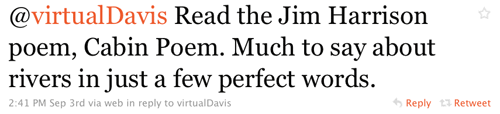
“Read the Jim Harrison poem, Cabin Poem. Much to say about rivers in just a few perfect words.” ~ Laura Munson

It was Friday afternoon and I was headed off to opening night of Mrs. Farnsworth in Saranac Lake. I was running lines in my mind, driving through the Adirondack’s High Peaks. I wasn’t tweeting. Not much anyway! And I didn’t have time to look for Jim’s Harrison’s “Cabin Poem”. This morning I did. With two performances complete, and a tsunami of family and houseguests moving back out to sea, I’ve had time to sit down at my desk and begin catching up. And in the midst of catching up, I rememberd Laura’s recommendation, so I Googled Jim Harrison’s, “Cabin Poem” and read the brief but reflective poetry. Then reread it. Again and again. Then pushed my seat back from my cluttered desk and walked across my study to an arm chair, warm in the morning sun, and settled in to ponder while listening to the waves crashing against our dock house beyond the open window…

I’ve decided to make up my mind 
about nothing, to assume the water mask, 
to finish my life disguised as a creek, 
an eddy, joining at night the full, 
sweet flow, to absorb the sky, 
to swallow the heat and cold, the moon 
and the stars, to swallow myself
in ceaseless flow.
Jim Harrison, Cabin Poem

The strong Buddhist undertone aside, don’t you hear the Twitter overtone? I’ve certainly allowed myself to be swallowed in Twitter’s “ceaseless flow” more times than I care to keep track of. Which takes us back to where I started, to the pros and cons of this curious phenomenon called Twitter. It can be a tempting time suck. Yes. And sometimes that’s what we want and/or need, even when we resist admitting it. Swimming in a massive conversation about ideas that interest us, that connect us with others who are interested, interesting, challenging, educating, inspiring. Submitting to the “sweet flow”…

If you’re new to Twitter (or puffing out your chest for resisting that pointless waste of time) then you might not have had the opportunity to evaluate the rewards, the sheer joy of the sort of tweetalogue I’ve just recounted. Clearly Laura Munson, who I’ve never met, feels otherwise. And I’m grateful and richer for it! Thanks for guiding me to this insightful poem.

Enhanced by Zemanta

Liu Ling’s Trousers

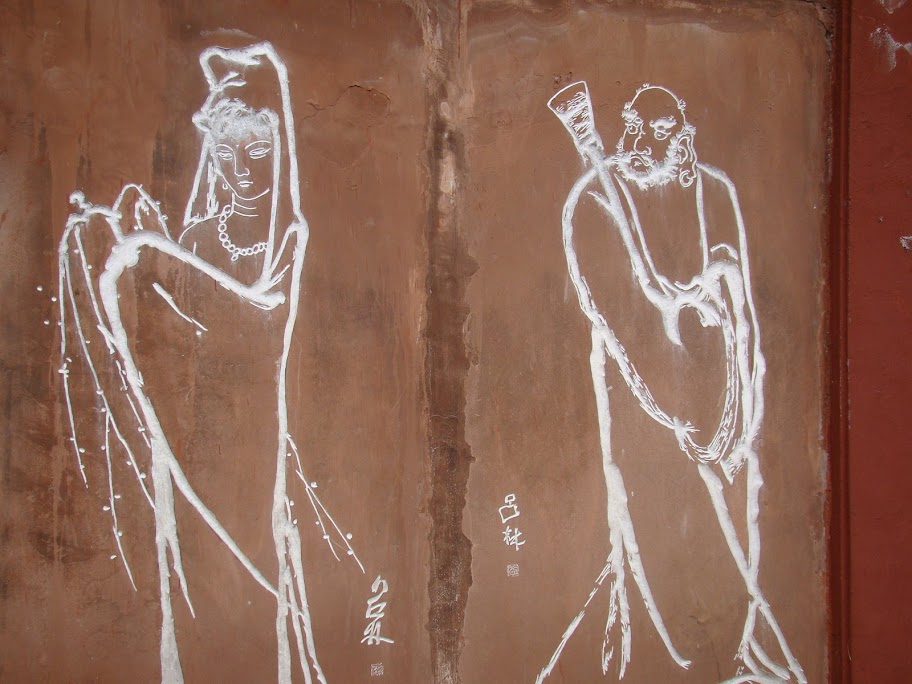
Forest Sages
Forest Sages, Leshan, Sichuan (via tedmitew.com)

On many occasions, under the influence of wine, Liu Ling would be completely free and unrestrained, sometimes even removing his clothes and sitting stark naked in the middle of his room. Some people once saw him in this state and chided him for it. Ling retorted, ‘Heaven and earth are my pillars and roof, the rooms of my house are my jacket and trousers. What are you gentlemen doing in my trousers?” (via tedmitew.com)

What better chuckle for Labor Day than a cheerful tangle of wisdom and levity from poet and fellow flaneur Liu Ling?

Enhanced by Zemanta

Thus Spoke Seth Godin

In the still buzzing world of “Seth Godin versus print publishing” much has been said in favor and against Godin’s announcement that he will no longer publish books traditionally. I’ve been fascinated with the debate. I’m an unabashed neophyte in the world of agents, editors, publishers and book retail, and I profess to know little as a still-hopeful in the world of publishing. But I’m a fan of Godin’s ideas, energy and quasi oracular vision, and I’ve been fascinated with digital storytelling in its diverse and perennially morphing potential for a decade.

Back in the shadow of Y2K I lead a workshop in Paris for teachers called Storytelling in the Digital Age that explored the merits of (and methods for) embracing new narrative media in the classroom. That workshop evolved into a semester-long elective for high school students at the American School of Paris, exploring the roots and evolution of storytelling while developing a methodology for digital narrative craft. Remember, those were heady days when Dana Atchley was at the peak of his all too short life.

It’s stunning how much has changed since then. Staggering. And not a little scary (ie: “One Dark Side of Publishing Changes“) either… But it’s also thrilling and exhilarating! And inevitable. Though not everyone agrees on this last point. In evidence, consider this poignant request from the sage, book loving Gail Hyatt:

It’s true that things are changing drastically in the world of words and ideas. Nobody knows this better than you. You’re a big reason. The possibilities are being realized faster than we can absorb them. However, in my opinion, the end of traditional publishing has not yet come. Not at all. It has a most crucial and vital part to play in feeding our souls and our minds and challenging us to change our lives. I see this fleshed out in my own home. Mike’s chair is the perfect example. Propped in the seat is his laptop, waiting to be awakened for the day. The iPad is perched on the side table next to THE DIP and the highlighter, and the is Kindle peaking up from his briefcase on the floor waiting to be compared to the newest Kindle which will arrive sometime today. I want to encourage to rethink this “quitting.” You say one has to know when to quit and when to stick. Don’t quit that which is obviously sticking. You and your works have a place in our lives that will never be unstuck and we’re very grateful for that. I think your best work is yet to come … and that’s saying A LOT! Maybe not right now. Maybe it needs to ferment for several years. Who knows? All I hope is that, when it does come, you don’t quit and you give it to us in every form possible—especially traditional publishing. Please reconsider. (The Treasure Hunt, by Gail Hyatt)

And while Gail Hyatt is begging Seth Godin not to quit, many others are excoriating and chastising him for his decision. Fortunately, there are also some level heads approaching Godin’s announcement with a more metered, more academic interest. For instance, Mitch Joel shares the feedback from his literary agent, James Levine, regarding four critical considerations for other writers considering emulating Seth Godin:

  • Fan base. Must be fanatic, very large, and inclined to read the author’s works in digital format. This won’t work right out the gate for authors whose main following is in print.
  • Marketing savvy and support. Aside from being very smart about marketing, the author needs to have the staff in place to execute, execute, execute, daily, daily, daily. Many authors will underestimate how expensive and time consuming this is.
  • Long term money goals. The author needs to be able/willing to forego the short-term guarantee from a publisher [known as “the advance”] and bet on long term sales direct from consumers (the per unit revenue to the author is much bigger when the author acts as the publisher).
  • Platforms. It’s important to realize that this approach will make the most sense for authors who make most of their money by speaking/consulting to business audiences. In this sense, books are a form of advertising for the more lucrative services provided by these authors. (“You Are Not Seth Godin“)

Joel adds two further essentials: a top flight editor and a team of performance driven sales reps. Starting to sound like going the Seth Godin way involves launching your own publishing company? To some degree, yes! Joel goes on to remind us that Godin’s ability to make this brave decision nevertheless relies on more than these parts. Godin tirelessly invested “decades of doing tons of things… that all had him in direct connection with the people who will buy his books from him, talk about it to their peers and evangelize his always-brilliant thinking.” In short,Godin has a world class platform. Do you?

What Seth, The Wall Street Journal, the book publishing industry and the literary agents aren’t telling you is that you can – in fact – be just like Seth Godin. These Digital Marketing channels are here for you (and they’re free – if you don’t count the time you need to put into them). In text, images, audio and video you too can publish how you think to the world… instantly. You too can share with others, build relationships and get your ideas to spread. You do not have to rely solely on mass media to help spread the word. And, you’ll know in short order, if your idea has traction… and you’ll be able to track how that idea spreads and connects.

In the end, you are not Seth Godin, but you can be. (“You Are Not Seth Godin“)

In Seth Godin’s words, “The business race is on to have the relationship with the reader.” According to Mark Coker (CEO of Smashwords) “the distribution advantage of having new titles in bricks-and-mortar bookstores will have to be weighed against the potential financial advantage of retaining ownership of a new book and distributing it as an e-book or on a print-on-demand basis.” Makes sense, right?

But others argue that this misses the point. Joel J. Miller argues that Godin has misunderstood “what traditional publishing is about. We sell books to people who love them, to people who crave them, who love bookstores, who love reading…” True. And you sell books to lots of other people who don’t love them but need them, rely upon them, etc. And you may be missing an opportunity to sell books to lots of people who simply haven’t considered buying them because they don’t love them, don’t need them, don’t rely upon them, etc. Right? Wrong, says Miller.

Godin’s basic misapprehension is that people don’t like books. There are billions of dollars exchanged every year that say differently. If you’re a reader, your own habits probably say differently. Mine do.

The second misapprehension is that books are a clunky way to deliver and spread ideas… For people who love them, there are few things more elegant or efficient than books…

A third misapprehension is not Godin’s fault. It’s our own. Godin’s personal business model is perhaps set up for him to succeed with this independent adventure. Good for him. Most authors, however, are not set up to go it alone. Likewise, most publishers are not set up to translate many of Godin’s ideas into their models. As authors and publishers, we should spend more time trying to please our customers than trying to justify ourselves to, or square our practices with, Seth Godin. (“What Godin gets wrong“)

I think this last issue is probably true. At least until the new digital publishing industry matures and begins to offer plug and play solutions to many of the challenges an indie author would encounter. And true too that most traditional publishers aren’t equipped to learn/adopt much from Godin.

But the first two “misapprehensions” strike me as somewhat naive. Sure, some people like and will continue to buy books, and many of those book buyers do indeed consider print books to be elegant and efficient. I am one of those book buyers. I love books. I will always love books. But that’s not the point.

I also love wine, and I am particularly fond of the ritual of opening a good bottle of wine. Cutting the foil is like breaking the wax seal on a letter or document, bold and permanent and assertive yet beautiful and not a little poignant. Once the foil or leading is trimmed away tidily, there’s no greater satisfaction that removing the cork from an aged but well maintained bottled of wine, each twist of the corkscrew adding to the anticipation…

It’s easy to romance wine corks. It’s easy to romance books. And with luck and sufficient numbers of passionate book and wine consumers, we’ll be able to enjoy both for a long time into the future. But screw caps, with all of their oenological, environmental and economic logic are making rapid inroads, and the likelihood of screwcaps gradually eclipsing corks is increasing with every vendange. The point isn’t that some of us prefer corks, but that the industry is changing because there’s greater oenological, environmental and economic value in screwing than corking! Does that mean that corking is dead? Probably not. But it’s likely to become exceptional, less widely available, and more expensive. Miller seems to miss this inevitability.

Literature is like running. It’s not for everyone, but for people who love it stopping after four blocks fails to satisfy. There are miles to go. It’s immersive. It’s also time consuming, but real readers are like real runners; you settle into a good pace and time evaporates. People whose primary reading is Facebook and street signs might not get that. Fine. Selling books to them is a waste of time and effort. Thank God that’s not the task before publishers. (“What Godin gets wrong“)

Whether or not literature and running are similar is a dabble for another day, but it’s clear to me that Miller’s off target. The shifting of the publishing industry from print to digital isn’t about those who love books, love running or love corks in their wine bottles. And if his oversimplified notion that the digital alternative to elegantly bound tomes is blog posts and Facebook, then it’s no wonder he’s confused and concerned. We’re at the dawn of digital publishing. The user-friendly innovations that will propel digital content into the next century aren’t even dreamed up yet. NookKindleVook, etc. are mere prototypes for the next generation of content conveyances. But they are already considerably more evolved and useful as digital publishing platforms than blogs and Facebook!

Clinging to an industry which has largely grown obsolete is lamentable, but failing to recognize the inevitability of the shift and failing to recognize the enormous potential represented by the shift is indeed naive. Let’s be frank and honest; the publishing industry not only resisted change, it kept its head in the sand for far too long. This change isn’t happening overnight. It isn’t an unanticipated fluke. It’s been a gradual evolution, the slowly building wave that only recently has started to crest!

The music industry offered possibly the best case study and the most abundant lessons. If the Big Six had studied the music industry over the last decade and adapted the most successful lessons, they’d be surfing the wave now instead of paddling like mad! But the music industry is only one example. Reflect back on the transition from traditional film photography to digital photography. Remember the detractors, the naysayers, the purists, the film lovers, the darkroom junkies, the overconfident executives who scoffed at the need to reinvent cameras, developing and photography. And note too that evolution from film to digital photography is responsible for the virtual ubiquity of cameras today. Every gadget imaginable includes a camera, and the proliferation of photo sharing, archiving and publishing gadgets demonstrate that this evolution had the effect of democratizing photography. It also opened up massive markets that had been overlooked or unfathomable prior to inexpensive digital cameras.

I suspect this example is particularly relevant to the transition in the publishing industry today. Some people love books and bookstores. Agreed. But look at how many do not. Look at how many never even consider books. And recognize that like digital photography which has proliferated beyond anyone’s wildest expectations, the transition to digital publishing will similarly transform the production and spread of information. And though we’re not all Seth Godins, not by a long shot, this brave new world of digital publishing will make it possible for you, me, anyone with ambition, intelligence and hard work to develop a platform and build an audience who appreciate, justify and contribute to our literary creations.

Enhanced by Zemanta

Black Tie Beach


[youtube=http://www.youtube.com/watch?v=pjzPEqhELJ8&w=335&h=205]

Black Tie Beach improv theatre mission (via Improv Everywhere)

“I saw people looking and old people laughing… You move… make spirit… people… It’s good fun. I tell what I am feeling. Everybody’s happy!” The old fellow at the end of the video nailed it. Improv Everywhere moves people. Make people laugh. Makes people happy. Another you’re-making-the-world-a-better-place mission. Thanks!

A Muse to Amuse Your Ego

I’ve just polluted a perfectly wonderful blog post over at Multi-Hyphenate, and I’m feeling a little ashamed.

No, not the blog troll sort of graffiti that I find reprehensible. But the kind of run-on comment that should have been a blog post instead of clogging up someone else’s blog post (which I alsofind reprehensible.) So… aside from a mumbled apology at the end of my comment, I’m reposting my thoughts so their wise editor is free to abbreviate or remove the comment I posted to Annie Q. Syed’s “There is No Muse“.

A “muse to amuse your ego” is an amusing and clever tongue twister that I can’t resist borrowing for a quick blog post… But I’m not sure I’m 100% convinced.

I’m with you here: “At the end of the day… you are simply a storyteller and you have a job to do: tell the damn story. ” Just spent this morning listening to Tom Ashbrook interviewing Eric Bogosian about his novel, “Perforated Heart”. (You can hear the On Point rebroadcast, but note it was originally broadcast May 26, 2009.) He tells the story. In more modes, manners and muddles than most storytellers,

Eric Bogosian

Eric Bogosian (Image via RottenTomatoes.com)

Bogosian tells the damn story. An acquired taste, especially if you’re not male and/or not connected in some way with NYC, but Bogosian is a storyteller without precious, pretentious muse mongering.

Or is he? Perhaps we just don’t meet his muse. Perhaps Bogosian’s muse is personal, intimate, private. Perhaps it is a changing muse, evolving along with his own writing style, ambition, skill. I don’t know. And frankly, I don’t much care because his storytelling stands on its own, muse or no muse.

What’s the point? I think that storytelling need not be divorced from muse. A muse. Many muses. But the story, the finished product, need not reflect the role of the muse in the creative process. A storyteller’s craft is complex, and the journey is often long (as you’ve readily acknowledged) between story seed and finished story. For me, the muse is one part of that journey. She’s part inspiration, as you’ve mentioned above, but she’s also my collaborator. I don’t mean to get too fanciful hear, but recall that storytelling is not a hermetic art. It requires an audience. Else it is mere babbling! The burps and farts of a crazy man. You’ve said, “Sometimes when I write words feel like picking precious beads in sand.” Right! And why? Because you’re not writing for yourself alone. You’re telling a story for an audience and precise, accurate language is the currency of a storyteller if s/he is to find a receptive audience. I’ve slipping into pedantic drivel, sorry…

So inspiration, yes, but my muse is also more of a collaborator. Like music to a dancer. And perhaps also like a dance partner. I’m a crumby (but enthusiastic) dancer, so take this comparison for what little it is worth. I can dream up a clever dance, practice and refine my steps, my rhythm, my gesture, my poise, etc. But it’s only when I attempt this creative process in conjunction with music — real or imagined — that my dance evolves away from the dizzying courtship of a park pigeon into something more compelling, more complete. And better still when I extend my hand to a dance partner — real or imagined — to enter into the dance with me, to mirror, to oppose, to resist and beguile and charm and challenge that something beautiful can be born.

Yes, I’ve overextended the metaphor. Apologies! But there’s an idea in there, an idea that a creator can extend the limits of his or her creativity significantly when amused by a muse. ;-)

That indulgent difference aside, there’s much we agree on. The work of a storyteller is also to know the difference between this creative dance and the hard work of distilling the finished product from the draft. After narcotic creativity transports the storyteller beyond initial inspiration and indeed often beyond the anticipated scope of the story, it’s time to begin the hardest work. The editing, the weeding, the focusing, the revising. The muse does not belong in this process, at least in my own writing. She’s a temptress, a dazzling temptress who’s creative genius forever outstrips my own. And so the time comes when I must bid her farewell, for a while, remove my dance shoes, sit down at my desk and work. Dancing is divine, but I have a job to do!

A Cadence of Choice

What is the “rhythm of stillness”? An oxymoron? An invitation to pause and ponder? A whimsical poetic conundrum?

Annie Q. Syed is drawn to the rhythm of stillness experienced in those “quiet hours of the early morning before a city, town, or village takes a big yawn and stretches itself into your routine.” She dubs these rare but sacred moments Still Sundays:

“These mornings are especially unique in New York because the City doesn’t sleep but she just takes naps. And the longest naps are on Sunday mornings. I love Sunday mornings in NYC. I try my best not to have anything planned, not even a yoga class, before 12:00 p.m. If my mind is quiet enough I borrow the stillness and share some thoughts with a few friends or family members via email or a phone conversation. Some mornings I  simply wrap the stillness of a Sunday morning around a pen and put fragments on a paper.

Are you making time to be still? To listen to the stillness? This past Sunday Syed pondered a conversation she’d had with a friend who decried the perpetual frenzy and commotion of life in New York City. She wondered if, how and why stillness is possible (essential?) amidst the whirring, screeching, bumping, jackhammering, phone ringing, car door slamming, elevator bell dinging “city that never sleeps”. It is. She knows it is, and she wandered toward the reason why. Her reason why.

“New York didn’t define me; I defined New York. I believe the stillness I speak of is borne out of that carving. I can hear a steady beat inside the multi-rhythmic pulsating blend of music that can’t easily be tuned out. The tempo matches my heart. Stillness then is a cadence of choice.

At least most of the time. Carving out a space for stillness amidst the throng will open up the possibility of stillness. But there must also be room for chance, for stumbling accidentally upon these somewhat paradoxical interstices, and then honoring them. Syed doesn’t say this, not explicitly, but she recounts an anecdote that trumps any explanation.Tucked into her familiar routine of yoga class followed by pizza at an Upper West Side pizzeria, a fleeting encounter with Nina — a 78 year old Greek lady dressed in a pink skirt suit — offers an invitation to wander into the unfamiliar. Syed accepts the invitation.

If the rhythm of stillness seems to be drowned out by din and routine, it might not be New York City or Los Angeles or Chicago that have picked up the pace or turned up the volume. It might be that we forget to stop, to listen, to wonder. It might be that we’re not quite as receptive as we could be. Should be.

I’ve lived in New York City. I’ve lived in Washington, DC and Paris and Rome as well. Plenty of busy-busy in all of them. And so many reasons to ignore the old bat who says “Hello,” at the pizzeria or asks you how to find the Jardin des Tuileries. No time to stop and wonder at the thousands of tiny black birds painting paisleys in the sky above the Colosseum. Too busy to pause and listen to the girl practicing her cello at Abe’s left foot in the Lincoln Memorial. But, as Syed reminds us, there’s an opportunity lurking beneath the quotidian. Whether it’s an early Sunday morning while the “To Do” list is still snoozing, or squeezed in between a slice of pizza and a bus ride, there’s rhythm in the stillness. Will you stop to listen? To sing along? To dance?

Acknowledgment: Special thanks to Annie Q. Syed (@so_you_know on Twitter) who’s inspired me plenty in recent months, and who is is one of the reasons I believe that Twitter is a midwife for real friendship! And a hat tip to the late Paul Zweig who’s The Adventurer: The Fate of Adventure in the Western World is where I first stumbled upon this idea of interstices.

Enhanced by Zemanta