Manna from heaven! Just the pearls of wisdom that aspiring authors covet. Except when it contradicts their own experience. In fact, so much hullabuloo emanated from this claim that Friedman asked him to elaborate in a guest pos on her There Are No Rules blog. Sakey was quick to limit his assertion to fiction, “nonfiction is different, and I don’t know beans about it“, but I’m nevertheless drawn to his assertion that a query letter should not try to sell the book.
You are not selling the book… All you’re doing is seducing the agent. You want to get them interested enough that they ask to see your manuscript. That’s it. It’s like online dating. If you can write a charming e-mail, you might get a date; if you get a date, who knows where it could lead. But try to put all your history and baggage in that first message and you won’t get any play. Instead, demonstrate that you’re worth someone’s time. That you are interesting, sincere, and respectful. (How to Ensure 75% of Agents Will Request Your Material)
Makes sense to me! Of course, online dating still requires that you deliver the goods when you meet in person, or else Mr. Lonely will spend the rest of his days practicing his fly tieing and perfecting his hook while the fish get away again and again. Sounds obvious enough, but how do you interest the right agent? How do you demonstrate that you are worth their time?
Well, for one, you’re polished. Your language is compelling… your presentation is perfect… you’re brief. Agents are busy. There are hundreds of other queries to read. Finally, you are a storyteller. You know how to tease, how to intrigue, and you’re not afraid to put those wiles to work. (How to Ensure 75% of Agents Will Request Your Material)
The proof is in the pudding. Show; don’t tell. Am I missing a savory cliche? Perhaps, but the point’s clear and compelling: perfect hook + polished presentation + brevity = perfect pitch. But is it correct?
The Monti is my kind of place. Well, almost. They’re all about live storytelling and they’re all about community. So why almost? Because they aren’t a short walk away. They aren’t even in my community…
The Monti is an organization that invites people from the community to tell personal stories without the use of notes. It’s just simple storytelling. Each month, events are held around the Raleigh-Durham-Chapel Hill area and as far away as Greensboro. The goal is to create an intimate, open, and fun atmosphere where people can relate their personal experiences to one another through narrative… by inviting interesting people with amazing stories that amuse and compel.
This sounds like The Moth, another storytelling institution that intrigues me. I discovered both via NPR and have wiled away way too much time on their websites plotting participation… and imitation!
The Moth… is an acclaimed not-for-profit organization dedicated to the art and craft of storytelling… The Moth has presented more than three thousand stories, told live and without notes, by people from all walks of life to standing-room-only crowds worldwide. Each show features simple, old-fashioned storytelling on thoroughly modern themes by wildly divergent raconteurs who develop and shape their stories with The Moth’s directors.
I believe that storytelling is the glue of community. No, not just the glue. Storytelling is the lubrication of community. No, not just that either. Glue and lube? And lately I’ve been wondering if Essex, if the Champlain Valley is ready to plunge into our collective narratives. I believe (and hope) so!
Update: I’ve created a related oral storytelling mashup called Storytelling Unplugged for further information, and I’ve received a few notable additions from @TheMonti that I’d like to pass along (first four), and in the process of exploring these, I’ve stumbled on to some others. What am I missing? Please contact me via Twitter (@virtualDavis) or use the contact form on the the virtualDavis website. Thanks!
This oral storytelling mashup germinated from “The Monti and The Moth” and was initially intended as a scrapbook of storytelling venues around the United States. It has evolved to include rumination on traditional storytelling versus digital storytelling. Never mind the irony of non-digital oral storytelling being filmed, shared and enjoyed digitally!
Amidst the buzz and clang of digital storytelling, there are still those who practice the simpler, “purer” art of oral storytelling unfettered by connectivity, bandwidth, electricity… Whether by preference or as one of many modes of sharing a narrative Storytelling Unplugged aims to explore the enduring art of oral recounting. Less manifesto; more rumination. (And yes, I realize that the title is a bit of a misnomer since microphones are largely ubiquitous in the venues included below,)
I’m diggin’ it! Joined the beta (thanks, guys!), and I’m amazed at how powerful this tool is. It takes journalism and story curatorship off the page and out of the linear realm once and for all.
What follows is a digital mashup of my early foray into “storification”…
The image above was generated via Curate.Us one of the many innovative curating tools sprouting up lately. My current fav among the free online curating tools is Storify, co-founded by Burt Herman and Xavier Damman. Check out “My Storify Meta Story“, a still-evolving assessment and chronicle of my experiences with this powerful, user-friendly curating tool. In addition to an in-depth look at Storify, videos of Herman and Damman, and Twitter exchanges with Damman, I’ve included a look at some of the main competitors in the curation space including Curated.by, BagtheWeb, Scoop.it, Pearltrees and Keepstream.
Every day there’s more evidence that curating social media will take center stage in 2011. As more and more social media adopters share content, filtering and curating this avalanche of information has become critical.What curating tools do you favor?
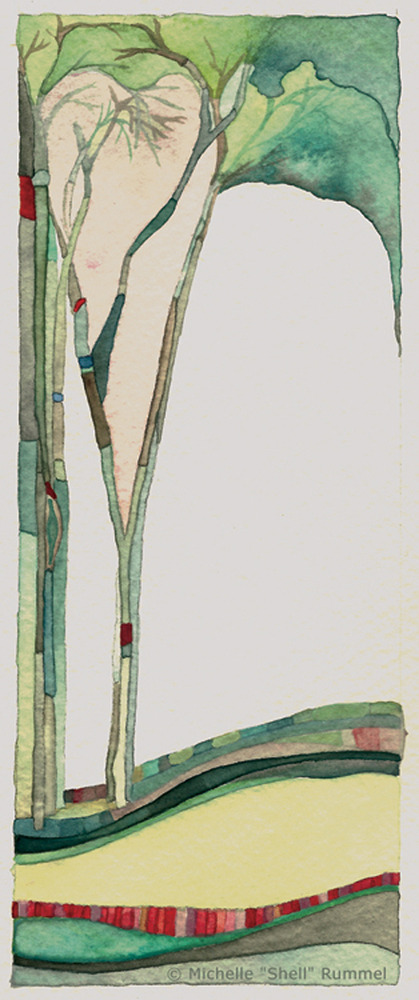
I’ve been longing for winter; its chill and drifts having mostly passed us by so far this year. And now — after wandering through this watercolor by Michelle Rummel (@shellartistree) — I find myself longing for spring! And I haven’t even planted seeds for my spring starts yet! An evocative and intriguing image, but the undulating forms and colors are only part of the story. There’s a playful energy too. I think it springs from the quasi-stainglass technique, breaking up fluid, representational forms with geometric lines and color changes. The scene is vibrating, slowly, quietly, enticingly. I’ll wander in again!
“I do hereby firmly resolve…” Each year as a child I wrote these words on New Years Eve. There was an uncomfortable gravitas that came with putting my resolutions down on paper, sitting in the living room with my parents, my brother, my sister, knowing full well that we would all be expected to share our resolutions aloud. Knowing full well that some of my inked goals were not new, were repeats from a year prior (and perhaps the year before that and so on.) In other words, some new years resolutions represented failures. By reaffirming that I would undertake what I had failed required humility and honesty. It also created optimism and hope. I had failed, but now I would succeed.
“I do firmly resolve…” That’s powerful language. A powerful act.
As an adult the gravitas diminished. Over time I abandoned much of the soul searching and honesty of defining and sharing specific, personal, intentional, meaningful resolutions. Toasts and lighthearted bravado eclipsed reflection and goal setting. Champagne, dancing, singing, hugs and kisses and thumps on the back. Each year I still try to jot down a few goals in my Blackberry to refer to over the course of a year, but the ritual of my childhood definitely lapsed.
Until this morning. I awoke knowing that something was missing. It was time to plant my keister at the honesty table for a little tough love. Did I rock 2010 the way I could have? Did I seize the most important opportunities? Did I achieve or significantly progress toward my goals? Have some of my goals changed? Is it time to weed out longstanding ambitions that perhaps no longer matter and replace them with new ones that do?
Before long my reflection yielded to hopes and plans for the new year. I scrawled out two pages of changes, improvements, goals and accomplishments for 2011, and then I massaged them into a prioritized, categorized layout. An action plan.
I felt pretty good.
But it’s easy to feel good writing lists, dreaming of what we want to achieve. Easy and often fleeting. The gravitas was still missing. The accountability. The humility and honesty that resulted from speaking my resolutions aloud as a boy. From owning and sharing and responding to questions and making a public commitment. “I do firmly resolve…”
Having dropped my parents off at the airport yesterday afternoon to fly home to Chicago, and since my siblings are far, far away, the tried and true ingredients for resolution gravitas were absent. Time for new ingredients. Time for reinvention!
Here’s what I’ve decided. I’m going to share a few resolutions with you to see if there’s gravitas to be had. To see if forging a compact with my virtual family can help me keep my 2011 resolutions. Don’t worry, I’m not going to swamp you with two pages of “Take the dog on more adventures” and “Share better wine with more friends” and “Go fly fishing!”
Like everyone else, I’ve pledged to supersize my fitness regimens. Yes, both of them!
Just as physical activity is essential to maintaining a healthy body, challenging one’s brain, keeping it active, engaged, flexible and playful, is not only fun. It is essential to cognitive fitness. (This Year, Change Your Mind)
Now that the holidays are fading in the rearview mirror, I’ll be more successful at dealing with the decadent dining dilemma: downsize, downsize, downsize! There are work resolutions (Drupal, Drupal, Drupal) and personal resolutions (gardening, orcharding and timely thank you notes) too, but it’s my bookish resolutions that I need to affirm publicly (“One thing only needs your attention…“) so that you can bust my chops when I get distracted, discouraged and/or delusional.
That’s right. Part of effective New Years Resolutioning is going on the record and proclaiming your goals openly so that others can help you monitor your progress and ultimately succeed. You in? Thanks.
My #1 resolution for 2011 is to deliver Rosslyn Redux to its audience:
to publish the print memoir and the ebook;
to record and distribute the audio book;
to publish the video series;
to perform the one-man show;
and to share my quixotic publishing adventure with you as I move toward my goal.
Whiplash? Thwappp! It’s real. It’s happening. It’s now. And I’m going to take you along for the ride via twitter, video, blogging, storify and [hopefully soon] broadcastr. A glimpse inside the adventure of a newbie writer courting a publishing industry doing the funky chicken in time lapse animation. You with me? Hang in there. Things are liable to get even more confusing in the months ahead, but we’ll muddle through. And laugh at ourselves plenty along the way.
As I plunge head over heels into an exotic publishing adventure, I’m going to chronicle the conversations along the way. I’m going to write in the margins. And I’m going to share my marginalia with you. In fact, I’ve already started… I hope you’ll help keep me honest, focused and determined. And I hope you’ll bust my chops when I get distracted, discouraged and/or delusional. Thank you!
I do hereby firmly resolve to publish Rosslyn Redux in multiple formats and to share my experiences over the next year while moving toward this goal. Gravitas!
I’d love to pass along some of the stunning photographs, but an enthusiastic security guard cum docent spent about five minutes explaining to me that strict copyright rules prevented me from snapping any photographs. Fair enough. But if you follow the link above to the exhibition you can see some great images including the one I’ve included here and “Winter Sunrise, Sierra Nevada from Lone Pine, California” which I included in my last Ansel Adams post.
So, until you meander over to the Shelburne Museum’s Webb Gallery, you’ll have to rely upon my words. Or perhaps not rely upon, since the verbal journey you’re about to experience is impressionistic and highly subjective. Consider my stream of conscious reflection less review, even less blog post than a composite Ansel Adams and Edward Burtynsky twitter stream…
Data Stream: Ansel Adams & Edward Burtynsky
You with me? When the guard welcomed me into the exhibition and then launched into his routine about why photography was prohibited, I asked if I could tweet my way through the photographs. He wasn’t so sure about this Twitter business, but he agreed. Victory! Or not. I quickly discovered that the Webb Gallery is a “zero bar” Verizon black hole. Strong signal outside, but zilch inside. So, I resolved to jot my Ansel Adams / Edward Burtynsky impressions on my Blackberry to post later. Here’s the soppy mess with a few links, etc. added in for good measure.
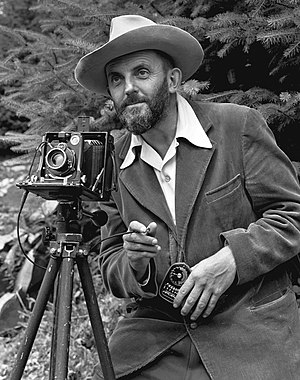
Ansel Adams (Credit: Wikipedia)
Spectacular photo: “Dunes, Hazy Sun, White Sands National Monument, New Mexico” of wild grass, yucca and a dead shrub drowning in cascading sand. (Tiny version of this the The Art Institute of Chicago’s website.) What’s grabbing me here? Nostalgia? Yes. I’ve been there. Envy? Sure. I’ve shot hundreds, maybe thousands of images at White Sands National Monument, influenced like millions of others before me by the photographs of Ansel Adams. Humility is good. But there’s something more. The tonal range is impressive. The totally pedestrian subject and framing adds to the mysterious appeal.
And another, “Forest, Early Morning, Mount Rainier National Park, Washington” presents three layers of visual story telling:
In the foreground, black silhouetted coniferous trees march left to right across the entire bottom of the image. Small, uniform shrubs at left grow larger and more detailed as they near the bottom right. This is a diminutive vignette, never taller than about 20% of the image.
The middle band, occupying nearly half the height of the image captures two jagged mountain peaks like portraits. Shear angled stone faces, some portions veiled in snow.
Above the mountains contrast-rich clouds drift nebulous and taunting, part steam engine blast, part crumbling doily.
The three layers of the image coalesce, but just barely as if the photographer is conflicted about his subject. Or triplicitous.
I am drawn into Ansel Adams’ “Tenaya Creek, Spring Rain“, the movement (and sound) of icy water riffling over stones and around boulders in the shallow creek bed. The textures — of the pebble beach, of the cedar trees’ bark, of the diversity of leaves — beg me to touch the print, to run my the pads of my fingers over the various surfaces. I restrain myself. Glass will restrain those who can’t resist. I yearn for half an hour, even fifteen minutes in this place. With my fly rod. With my Labrador Retriever, Griffin. With no mobile phone, no twitter, no appointments missed or pending, no urgencies at all.
Other favorites include Ansel Adams’ “Aspens, Northern New Mexico“, “White Branches, Mono Lake, California”, “BridalVeil Fall” and “Trees and Cliffs“, the latter cropped compellingly if slightly unconventionally. It seems to be off kilter, and a branch reaching into the top of the image suggests a tree falling out of celestial nothingness. Two trees (perhaps sequoias?) roughly divide the image and the asymmetrical massing of the stone mountains behind contribute to an effect furthered by the wispy clouds which radiate away from the center of the image. An eruption. An uprising. A rocket.
I remember studying Ansel Adams’ zone system. I remember frustration. Then amazement. “Dunes, Oceano, California” coerces me to linger while I trace the contours of the dunes, blur the wavy surface of the sand like a zebra in motion Laughing. Then lying down to rest. With the sun dropping nearer to the horizon.
Ping Pong: Ansel Adams & Edward Burtynsky
A sort of emotional schizophrenia ping-ponging back and forth between Ansel Adams and Edward Burtynsky: black and white, color; small prints, large prints; pristine, untouched nature, nature transformed by industry.
A dramatic Edward Burtynsky photograph, “Shipbreaking #24, Bangladesh, 2000″, showcases a cross section of a dismantled ship. A slice of steel vessel still bearing the name Kingfisher painted on the hull. The caustic pallet of hazy, pale blue and orange is unsettling, disturbing. I find myself wondering about the chemicals saturating the mudflats upon which ship carcasses are strewn in various stages of butchery. I worry about the health, the safety of the half dozen laborers who stand near the hulking Kingfisher. Smoke or exhaust lingers in the air. What is burning?
Burtynsky’s “Densified Oil Drum#4” intrigues me as much for the title as the stack of compressed steel drums. They remind me of clothes and rags packed into cubes, so untrained is my eye to seeing cylindrical steel drums so totally distorted, compressed, densified. So many colors of paint, crumpled, chipped paint homogenized by the patina of orange rust which — together with the geometry of the cubes stacked with some sense of order — unifies so many parts into a whole. Not an accident of industrial waste. Not a practical side effect of recycling. But a post industrial igloo, perhaps better suited to a globally warming world. And “Nickel Tailing #5” offers an even more colorful, even more dramatic, even more alarming refrain to Burtynsky’s anthem. It’s disheartening and defeatist from where I stand. Alone. In a cold gallery. Torrid July weather awaiting me outside.
Scenery is for Profit, Nature is for Reverence
As I wrap up, I reread one of many quotations printed on a wall:
“Scenery for Adams is a dirty word, an invention of the tourist business, an oversized curio. Nature is something else. Scenery is for profit, Nature is for reverence, and the fewer tracks of man there are in it, the better.” (Wallace Stegner’s foreword to “Ansel Adams Images, 1923-1974”)
What does tomorrow’s publishing world look like? MediaBistro’s eBook Summit dove into the “New Era of Publishing” on December 15, 2010 at The New Yorker Hotel to explore “some of the most pressing industry issues” and to assist writers, editors, publishers and agent in navigating “the changing industry ecosystem.”
In January I start pitching Rosslyn Redux (Writer’s Digest Conference 2011) to a publishing industry that is not only new to me but new to itself. I figured this conference would serve as an informative industry barometer for me and an up-close-and-personal glimpse at how traditional publishers and agents are adapting to the Post-Gutenberg Paradigm. The day was an eye opener. I’ve overviewed the highlights here…
Brendan Cahill, VP and Publisher of Open Road Integrated Media (ORIM), was lead presenter during eBook Summit 2010 last week in NYC. He set the tone for a forward looking agenda in the publishing industry, “pioneering an alternative publishing model”, where digital books replace print books at the epicenter.
Although Open Road (@openroadmedia) is only a year old, they’ve already made a major push in publishing ebooks and have set an ambitious target of 2,000 new books to be published in 2011! They are effectively producing more content per title than traditional print publishers (including HD video author and book trailers) and yet they’ve slashed the standard industry production time line from a year or more among traditional publishers to approximately 120 days at Open Road.
How is this possible? This shrinking book cycle (rights acquisition, manuscript editing, cataloguing, soliciting, fulfillment and marketing) critical to their rapid upscaling and early mover success depends upon a new publishing model: outsource, outstource, outsource. Virtually every stage of the traditional publishing process is outsourced except for acquiring rights and marketing which allows ample flexibility for editing, art directing, etc. Check out the first few slides of Cahill’s presentation below.
Speed to market and scalability is possible at least in part because Open Road is primarily publishing athors’ back list books. Nevertheless, Cahill assured us that the their 2,000 title goal for 2011 does include “e-riginals—original e-books—which he said were a small part of the company’s business, but were critical to its identity.” (Publishers Weekly)
In addition to a new publishing model, Cahill distinguished Open Road’s new book marketing model from the ingrained paradigm employed by traditional publishing companies. The new model integrates content communities, social networks, blogs and microblogs, videos/photos, retail and ratings.
Cahill spoke about how Open Road Media uses the Internet to connect their readers to authors. The digital publisher creates author pages with videos and photos, as well as social media accounts to help build a platform for the write online. “We follow the marketing process to empower the author to connect with readers,” he said.(eBookNewser)
Cahill explained that professionally produced high definition video is “one of the core offerings that we create…” He showed us a slick example of Midnight Guardians, by Jonathan King. The quality of the footage, editing and storytelling is superb! Cahill emphasized the short, enticing, syndicate-able and viral potential of the video content they are using to market their titles.
Affirming and reaffirming Open Road’s new media savvy was the strongest undercurrent to Cahill’s presentation, and it illumnates Open Road’s vision of the emerging publishing industry. Publishing tomorrow, Open Road believes, will focus on a quick and efficient acquisition-to-sales cycles and top notch marketing.
“Metadata is our sales force… We concentrate on marketing.” (Brendan Cahill)
This lean model shifts publishers out of the editing tradition and out of the book factory tradition. It seems considerably more sustainable in today’s marketplace, and it creates partnerships and lucrative synergies with businesses that otherwise might be direct competitors with a traditional publisher. Is this what tomorrow’s publishers will look like?
Kohlberg Ventures financed Open Road, so they must think so. And Open Road was cofounded by former HarperCollins CEO, Jane Friedman, and film producer Jeffrey Sharp, so they must think so. Established novelist Susan Minot thinks so. And so does debut novelist Mary Glickman.
What do you think? Is Open Road’s lean, quick-to-market and social media oriented marketing strategy a road map for tomorrow’s publishing companies?